Deprecated: Array and string offset access syntax with curly braces is deprecated in /home/sidehillgroup/old2.sidehillgroup.com/wp-content/plugins/Ultimate_VC_Addons/admin/bsf-core/auto-update/admin-functions.php on line 11

Warning: Cannot modify header information - headers already sent by (output started at /home/sidehillgroup/old2.sidehillgroup.com/wp-content/plugins/Ultimate_VC_Addons/admin/bsf-core/auto-update/admin-functions.php:11) in /home/sidehillgroup/old2.sidehillgroup.com/wp-includes/feed-rss2.php on line 8
Sidehill Consulting Group https://old2.sidehillgroup.com Tue, 12 Nov 2019 20:16:28 +0000 en-CA hourly 1 https://wordpress.org/?v=5.7.15 Sales Team Accountability: It’s a Good Thing https://old2.sidehillgroup.com/importance-sales-team-accountability/ https://old2.sidehillgroup.com/importance-sales-team-accountability/#respond Mon, 11 Nov 2019 17:30:00 +0000 https://dev.sidehillgroup.com/2017/06/02/the-importance-of-sales-team-accountability/ The post Sales Team Accountability: It’s a Good Thing appeared first on Sidehill Consulting Group.

]]>

Editor’s note: This post was originally published on 6/2/17 and has been updated for accuracy and comprehension.

Is your sales team meeting expectations

Try implementing accountability and get your sales goals met while improving the performance of your team.

How to establish and manage sales team accountability

  1. Establish clear sales team goals.
  2. Provide your team with the tools they need.
  3. Follow through with #1 and #2.
  4. Have pre-defined, consistent corrective actions in place.
  5. Manage numbers, lead people.

“Accountability” is a word that has many interpretations and is often thrown around in the business world without a clear representation of what it actually means. 

Everyone has a different view of what accountability means to them, so your sales team may think something different than you when you “hold them accountable.” 

Oftentimes, sales team accountability connotes negativity and punishment when that isn’t always the case. 

In fact, when organizations use accountability only for punishment, fear can permeate throughout the employees, making them nervous or unwilling to present new ideas for fear of failure and discipline.

However, if approached correctly, accountability within an organization can produce positive results. Accountability is a must-have for sales team members to both desire and maintain consistent performance. 

It improves rep retention and boosts organization culture. In short, when you have sales team accountability, your sales team goals are met, your team works better, and the whole operation runs more smoothly. 

All you need to do is create an accountability plan, and follow through on it.

How to Establish and Maintain Sales Team Accountability

You and your team must know what to do, how to do it and why doing it that way is important. 

If there isn’t a clearly established system of accountability, your sales team and sales team goals can easily fall apart. 

Start with a clear plan that gets your crew on board:

1. Establish clear sales team goals.

These goals should be backed with objective evidence that they can be achieved. 

Nothing will be accomplished if the sales team doesn’t know what is expected of them. It can be difficult to do their job when their goals are unclear. 

To clear up the murkiness, organization and sales team goals should be established, and your entire sales team should know what both are.

Then, show your sales team evidence that they can realistically achieve those goals. If your team doesn’t believe the goals can be met, they won’t work hard to reach them.

2. Provide the tools your team needs.

Give the team what it needs to achieve the goals. This can include:

  • Discussing behaviors required to produce expected results.
  • Defined differentiation, as well as target markets.
  • Marketing and Operations integration to smooth transitions from leads to active accounts.
  • Clear processes for accessing and winning assigned target markets.
  • Productivity tools, such as a sales automation system, customized for your unique processes, that easily tracking and manage account progress through the sales process, as well as automate reporting.

3. Follow through on the execution of 1 & 2 above. 

If you don’t follow through, your sales team will see there are no consequences for not hitting goals. 

The reverse is also true: If promised rewards are not delivered, the team may not work hard because they don’t believe they will be rewarded for closing a sale.

4. Have predefined, consistent, corrective action plans in place. 

This step is essential. 

If sales team members fall short, corrective action plans can help them improve without the fear of punishment. 

There should be no exceptions to this, especially for your top performers. Top performers can become complacent when there are no consequences for behaviors that fall outside the lines. 

Reward their exceptional performance in other ways that don’t include free passes on requirements the rest of the team must meet. 

Also, for sales team accountability to be thought of in a positive light, regarding exceptional performance will reinforce that performance and inspire other team members to do better.

5. Manage numbers, lead people.

Here’s how to lead people and manage numbers:

  • Duplicate and celebrate the wins. When specific elements of your sales process work very well for one team member, duplicate those actions across the entire team.
  • Adjust processes for system-wide misses. For example, if everyone is having trouble closing similar deals, adjust the process for that type of deal rather than a blanket correction for the whole team. Show your sales team that you are managing the numbers for their benefit so they all can improve and earn more.
  • Coach individuals for specific misses. Not every team member works and thinks the same way. Get into a one-on-one session, join a sales call or meeting with the individual, then review how the miss could have been handled differently and how that difference will help improve their performance for future sales.

Reaching your sales team goals

The end goal with accountability is to see positive results, consistently

Implementing sales team accountability requires communication, follow through, and meeting stated goals. 

Avoid using accountability as a means of punishment. Instead, use it as a way to improve the way sales team members think about what they are doing as well as improve the work environment, which will, in turn, improve your sales. 

Accountability is not just about higher sales. Practicing a constructive approach to accountability also improves individual performance, engagement, and participation, as well as increases commitment, creativity, and innovation. 

Accountability, properly structured and administered, leads to happier and more productive sales teams.

The post Sales Team Accountability: It’s a Good Thing appeared first on Sidehill Consulting Group.

]]>
https://old2.sidehillgroup.com/importance-sales-team-accountability/feed/ 0
7 Ways to Change Your Sales Culture and Increase Profits https://old2.sidehillgroup.com/change-sales-culture-increase-profits/ https://old2.sidehillgroup.com/change-sales-culture-increase-profits/#respond Mon, 04 Nov 2019 17:00:00 +0000 https://dev.sidehillgroup.com/2018/01/08/7-ways-to-change-your-sales-culture-and-increase-profits/ The post 7 Ways to Change Your Sales Culture and Increase Profits appeared first on Sidehill Consulting Group.

]]>

Editor’s note: This post was originally published on 1/8/18 and has been updated for accuracy and comprehension.

At Sidehill Consulting, we spend a lot of time working with and listening to business owners, presidents and CEOs. 

The consensus is clear – everyone wants to improve sales and increase profits. 

And nearly everybody agrees that, to do this, an organization needs to change its sales culture.

So, what does a successful sales culture look like?

Here’s a look at what a successful culture looks like and how to build one.

Sales Culture Definition

Your sales culture is made up of your team’s attitudes, values, and habits.

Commit to making a change

Changing sales culture may be a simple idea, but the execution is not easy. 

Several components are involved, but the most important is the commitment from business leaders. Leaders must be serious about affecting lasting, consistent, sustainable change by following sales culture best practices. 

Leaders are also responsible for setting the example for the rest of the organization. The commitment starts at the top and trickles throughout the ranks to the entire organization, especially to the management team. 

By committing to change the sales culture, you’re announcing your intent to:

  1. Change the results.
  2. Change the beliefs and paradigms of the organization.
  3. Change the attitudes of the organization.
  4. Change the behaviors of sales managers and salespeople.
  5. Change techniques, beginning with the sales management process.
  6. Install a congruent, effective sales process.
  7. Install an effective sales recruiting process.

The sales culture transformation

How to Change Your Sales Culture

  • Know your people.
  • Assess your sales force.
  • Communicate.
  • Choose a Culture Transformation Director.
  • Get buy-in from the people who will participate.
  • Be clear as to how your sales team’s success will be measured.

Whether you have a nonexistent sales culture or one that has been broken for some time, these seven steps will help with creating a sales culture that can support and drive profitability.

1. Know your people. 

First, realize that the very people you would like to change have chosen to do what they are currently doing. 

So, they probably won’t choose to do what you would like them to do – sell. 

Know that this process will take more than a few months and will hit a few obstacles.

2. Assess your sales force. 

Realize that only a small percentage of those people are suitable for taking on any part of a sales or business development role. 

Evaluate your sales force and identify that small percentage of people. It’s easy to do if you use the right types of assessment tools.

3. Communicate. 

Clearly communicate your desire to create more of a sales culture to the people that you’d like to be more sales aware. 

For example, perhaps you want branch managers at a bank to go out and find local business customers, or you want order takers to become proactive by making outgoing calls, or professionals to bring new clients into your firm. 

In any of these cases, the biggest common mistake is that management usually fails to communicate this expectation to the very people they would like to change. Clearly define what it is your team should do and how often they should do it. 

Setting and managing expectations is key.

4. Choose a “Culture Transformation” Director. 

This should be someone who understands sales culture best practices, as well as how to accomplish it and ultimately increase profits.

5. Provide training.

Provide the chosen team with the training they’ll need to succeed in this strange new world of selling and new business development. 

Use the data from the tool described in number two as a guide.

6. Get buy-in from the people who will participate. 

Their commitment to the personal and professional growth about to take place will be critical for the implementation and ongoing development of your new sales culture. 

Each member of the team has to want it, or they need to be on a different team.

7. Be clear as to how your sales team’s success will be measured. 

The Culture Transformation Director must hold the team accountable for doing what they agreed to do in number three.

Changing your sales culture

Change is always hard. 

Most employees and managers will not embrace changing the sales culture, at least not at first. 

There will be resistance. There will be turnover. There may even be sabotage. 

As a business leader, it’s your job to show them the way. Your commitment to change will build predictability and sustainability into the fabric of your organization. 

The results will speak for themselves when you emerge with a stronger sales team; one that welcomes accountability, behaves consistently and performs entirely differently than before. 

Sidehill Consulting is in the business of creating change, including within your sales culture. 

If your organization’s sales culture is stagnant, take our free Sales Agility Assessment to see right away what your sales operation might be missing. 

Then contact us to take the first step in committing to change. 

The post 7 Ways to Change Your Sales Culture and Increase Profits appeared first on Sidehill Consulting Group.

]]>
https://old2.sidehillgroup.com/change-sales-culture-increase-profits/feed/ 0
7 Essential Parts of a Sales Meeting Agenda Template https://old2.sidehillgroup.com/essential-parts-sales-meeting-agenda-template/ https://old2.sidehillgroup.com/essential-parts-sales-meeting-agenda-template/#respond Mon, 28 Oct 2019 14:00:48 +0000 https://old2.sidehillgroup.com/?p=1880 The post 7 Essential Parts of a Sales Meeting Agenda Template appeared first on Sidehill Consulting Group.

]]>

It’s 10 minutes past the time for the sales meeting to start.

Members of your sales team are still trickling in, looking disinterested and downright annoyed to be there.

What’s going on?

You need a sales meeting agenda template to add guidance and value to your time together.

Here’s what you need to know.

Why you need a sales meeting agenda

Why do you need a sales meeting agenda?

A sales meeting agenda keeps your meetings on track, engages the team, and prevents tangents that detract from the value of the meeting.

Winging it doesn’t work.

It’s the reason meetings have earned a bad rap as a waste of time.

Going in with a sales meeting agenda keeps you on track, ensures the team stays engaged and prevents those rabbit trails that can hijack an otherwise worthwhile session.

Let’s take a look at why you need a sales meeting agenda template to follow:

  • It’ll keep the team intensely focused on the most critical priorities.
  • It increases accountability for both the team and individuals.
  • It expose issues that may be holding the team back.
  • It helps to organize the discussion around finding solutions that work.

Now that you know it’s a necessary step, let’s take a look at what your sales meeting agenda template should include. 

Side Note: If you think this is a lot like an EOS Level 10 meeting, you’re right!

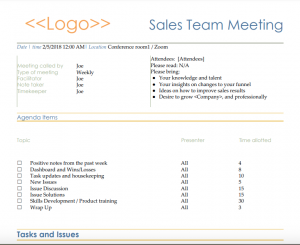
Sales meeting agenda template 

What are the features of a sales meeting agenda template?

  1. An introductory ice breaker
  2. Metrics dashboard
  3. Pipeline updates
  4. Issue resolution updates/General housekeeping
  5. New Issues: Identify, Discuss, Solve
  6. Training
  7. Closing

Here are the elements you should include in your sales meeting agenda, and that you need to take notes on.

1. An introductory ice-breaker

Spend about five minutes having everyone share, in 30 seconds or less, a high-point of the previous week for BOTH personal and professional experiences. For example: My new puppy is officially house trained, and I closed the XYZ opportunity!

Keep it brief, light, and positive – with bonus points for laughter.

2. Metrics dashboard

Cover important sales metrics in each meeting. 

Not an in-depth analysis, but rather a quick overview of the metrics dashboard for both the team overall and each individual. 

Everyone needs to be on-page with where the team is, and where each other is in relation to goals.

Make sure the metrics you’re looking at are tied directly to the organization’s overall goals, as well.

Note: 

This is NOT the time to call out individuals. Save that for one-on-one meetings. The purpose is transparency on what everyone should already know about their own performance and the impact their performance is having on the team.

3. Pipeline updates

Each team member shares status on their pipeline’s overall with focus on their best and most challenging opportunity.

This gives everyone on the team visibility into what’s working, as well as where they may be able to apply their experience to help others.

It’s also helpful for prioritizing activity for the week ahead.  

4. Issue resolution updates/General housekeeping

This is the time to give updates on open-task assignments in order to solve issues brought up in the prior weeks, as well as quick updates on other company initiatives, announcements, changes in policy, updates on processes, etc.

Keep it brief! Save the deep dives for the time allocated to training.

5. New Issues

Once everyone is up-to-date on the current status, it’s natural to jump into the challenges that have come up over the past week. 

I like the EOS model of Identify, Discuss, Solve: 

  • Identify: Get all the issues everyone has out on the table. This is like a brainstorming session: no filtering, no blaming or diving into details, just the issue. And it includes everything from being short-staffed during vacations to major technology failures and competitor activity.
    • A good example: Engineering response time is too slow.
    • Bad example: Every time I request technical support from Joe I never get anything for days and days, and it’s killing my pipeline. It’s like he just doesn’t care. The XYZ opportunity is about to die because… (you get the point).
  • Discuss: Once the issues are on the table, pick the ONE biggest hurdle, and talk it out. This is the time for everyone who has an idea to chime in with BOTH a “here’s how I see the issue” AND “here’s what I think we should do about it” approach. Provide the entire team the opportunity to contribute to a solution. 
  • Solve: Review all the “here’s what we should do about it” ideas, and map a path forward to solve the issue. Assign tasks with ownership and due dates as needed. The issue stays on your Issue list, and is brought up each week in #4 until it is solved..

6. Training

Your team will dread this time together if your sales meeting agenda template doesn’t include some deep content of immediate value.

Determine the areas where overall knowledge, skill, or execution are hindering success, and train up the team to overcome it. 

This IS the time to dive deep into self-limiting attitudes and beliefs, new tools, updated processes, product knowledge, etc. 

Provide actionable tips and best practices to address the skill, knowledge, and execution gaps  and make sure you send them off with a game-plan for tackling them.

7. Closing

Wrap up the meeting by re-emphasizing the most important points, including action items and strategies for the week.

Recap the wins/highs that were shared to reinforce the habits and behaviors you want your team to work toward.

Make sure everyone understands what their tasks are for the coming week and end the meeting on time.

Have everyone score the meeting, on a scale of 1 to 10, to see if the meeting was an effective use of their time.

After the meeting, publish the notes from the meeting, so tasks, issues, priorities, etc. are in writing for everyone.

Put your sales meeting agenda template to work for you

Following a sales meeting agenda template with consistency has the power to take your meetings from dreaded-waste-of-time to productive, energizing, value-packed sessions.

Taking the time to set up your sales meeting agenda will save you time – and money. And a structure will let your team know what to expect each week when you come together.

Here’s a template you can use to get started, but make it your own and tweak it to fit your team. 


If you need a strategist or an executor to pinpoint your broken systems and create a plan for long-term sales success and business growth, get in touch with Sidehill Consulting today.

The post 7 Essential Parts of a Sales Meeting Agenda Template appeared first on Sidehill Consulting Group.

]]>
https://old2.sidehillgroup.com/essential-parts-sales-meeting-agenda-template/feed/ 0
Why Leaders in Sales Fail – And What to Do About It https://old2.sidehillgroup.com/why-sales-leaders-fail/ https://old2.sidehillgroup.com/why-sales-leaders-fail/#respond Mon, 21 Oct 2019 14:45:00 +0000 https://dev.sidehillgroup.com/2018/11/05/why-do-sales-leaders-fail/ The post Why Leaders in Sales Fail – And What to Do About It appeared first on Sidehill Consulting Group.

]]>

Why do leaders in sales fail?

Many organizations lack the investment in adequate training that leaders in sales need to be successful. An outsourced VP of Sales can create the turnaround that gets sales back on their feet.

Editor’s note: This post was originally published on 11/5/18 and has been updated for accuracy and comprehension.

Salespeople are burning out faster than ever.

According to Forbes, it’s because they don’t have coaches and mentors to facilitate long-term success. 

Additionally, many salespeople don’t have adequate tools and resources to fulfill their job responsibilities. 

Their current leaders in sales once experienced the same pain years before the new hires ever did, so the cycle just continues. 

Why sales failures repeat

When things are going smoothly and the sales department is meeting its numbers, the organization’s leaders forget about the department and take advantage of the success it creates for the company. 

It’s only when things go wrong and there’s a sales failure – the numbers are less than expected, for example – that the organizational leaders remember that the sales department exists. 

With a glaring look and pointing finger, they blame the leader in sales for the company’s lack of performance. 

Sales departments are often overlooked as a primary business discipline and are only thought about when things go wrong. 

Why are sales – something vital to the existence of any firm – a secondary thought for so many organizations?

The problem all leaders in sales face

Perhaps it starts with the education many of us first receive at business school. 

Our days are filled with less stress, not as much sleep, and more fun – never focused on sales classes. 

All the other main functions of business are taught – from marketing to business data analytics and even tourism management – but not sales! 

If salespeople never have any formal training implemented from the beginning, where do professionals go to learn more about best sales practices? 

Simple: their sales leaders

With fresh eyes and a will to learn, many novice salespeople gain their leadership skills and practices from their own bosses. 

This isn’t the problem. 

The issue is the lack of training and development given to the initial leaders in sales from the organization. 

Little thought is given to that person’s ability to perform and execute the duties of the job. 

It’s likely the organization is simply relieved to fill the role. Yet it’s not the organization’s fault because no one understands sales enough to create a meaningful training program in the first place. 

No one has ever understood sales the way we understand the law of gravity or how to analyze a simple balance sheet in accounting.

The sales success solution

With all the new resources coming into play, like CRM software and endless data analytics, sales is gaining importance in the eyes of organizations, which means companies need a reliable sales leader. 

The solution if you don’t currently have one? Use a fractional or outsourced VP of sales. 

Sales has not been one of the departments that organizations are applying the outsourcing model to, although its implementation has been successful elsewhere in companies. 

It can be challenging to embrace the idea that a highly-qualified sales leader working part-time can accomplish more than an inexperienced one. 

The bottom line

As leading sales professionals, we’re repeatedly taught how to execute sales functions, increase growth and focus on the numbers. 

But, we’re never quite set up for success, even with all that insightful sales experience. You need more than your advanced experience and sharp intuition to be successful. 

Bring in a seasoned leader in sales to do an organizational assessment and allow them to act as a VP of Sales until you’re at a place where you can hire your own.

The post Why Leaders in Sales Fail – And What to Do About It appeared first on Sidehill Consulting Group.

]]>
https://old2.sidehillgroup.com/why-sales-leaders-fail/feed/ 0
How to Be Successful in Sales: The Trick to Taking Control of Your Sales Brain https://old2.sidehillgroup.com/trick-taking-control-sales-brain/ https://old2.sidehillgroup.com/trick-taking-control-sales-brain/#respond Mon, 14 Oct 2019 14:00:00 +0000 https://dev.sidehillgroup.com/2018/02/16/the-trick-to-taking-control-of-your-sales-brain/ The post How to Be Successful in Sales: The Trick to Taking Control of Your Sales Brain appeared first on Sidehill Consulting Group.

]]>

How does your mindset affect sales success?

Your subconscious and conscious thoughts can work together toward the positive or negative. Learn how to be successful in sales by turning positive thoughts to positive results.

Editor’s note: This post was originally published on 2/16/18 and has been updated for accuracy and comprehension.

Scientists have been studying the human mind for centuries. 

In the early 1900s, breakthroughs by Freud, Jung and others led to an understanding of the presence of subconscious thought. 

Since then, advancements in neuroscience, combined with new ultra-sensitive equipment for monitoring and measuring brain activity, have dramatically increased our knowledge of how the brain works.

Then in the early 1960s, research first demonstrated the connection between the subconscious and conscious mind concerning attitude. The research confirmed theories that the subconscious focuses on needs, wants and desires and how to obtain them.  

So how does that relate to harnessing your sales brain or answer the question of how to be successful in sales? 

The link to sales success

One of the most important findings was that, unless we provide direct input on what we want, need, or desire, the subconscious will make something up based on our day-to-day experience. 

The subconscious is generally focused on the optimistic view – thoughts like “How do I get that?” instead of “I don’t think I can have that.” 

The subconscious mind is creative, positive and goal-oriented; it constantly works behind the scenes to define and seek out ways to get what we want – including how to be successful in sales

The perfect sales brain!

Mindset is everything in a sales brain

Unfortunately, the subconscious brain has a counterpart that is much less positive. 

While the conscious mind is also focused on achieving the task at hand, it’s more logical, negative and past-oriented. 

Day-to-day life for a salesperson is full of negatives. Maybe turnover is high and growth isn’t sustainable. Perhaps their trying to work with a broken sales structure.

The tendency to hear more bad than good news, combined with the normal rejection of selling activity, can put salespeople in double-negative input jeopardy. 

This double negative does NOT make a positive! 

Positive thought leads to positive results. You can take control over both your subconscious and conscious thoughts. 

Here’s how:

  • Direct your subconscious to focus on what you consciously want by presenting it with well-defined goals. The subconscious will then work behind the scenes on ways to reach those goals.
  • Be explicit in your directions! If the majority of your daily experience is unproductive or negative, the natural optimism of the subconscious accepts that input as a confirmation of what you want and then works to help you obtain more of it.
  • Control your conscious thoughts to also focus on positive resolutions to challenges. Just by thinking about potentially positive outcomes, you ignite the sections of your brain that store pleasant memories. Active conscious thought helps neutralize the negative.

When the conscious and subconscious are working together, you’re focused on creating solutions that move you forward. 

You’ll be more open to the guidance of a strategist who can pinpoint your broken systems and help you create a plan for long-term growth.

Instead of being limited by the [negative] warning signals of the past, you can incorporate them into a plan for success.

The attitude of sales success

“If you think you can do a thing or think you can’t do a thing, you’re right.” -Henry Ford

A positive, conscious mind is the difference between success and lack of success. All too often, past experience influences what you believe you can accomplish in the future. 

For example, if you have never been artistic and can’t draw a recognizable circle, you’ll tend to steer away from opportunities where drawing circles is required. 

Fortunately, study after study has proven that, with very few exceptions, anyone can change their ability to succeed by making conscious choices in how their brain works. 

A positive attitude focuses your conscious mind on the potential – not on the past. 

Focusing on what is possible overrides the default protection mechanism of the conscious and combines the power of both the conscious and subconscious toward achieving the potential. This increases belief, which leads to improved confidence. 

Improved confidence makes it easier to see potential. 

So, if you think you can sell, or think you can’t sell, you’re right. 

How to be successful in sales

Your subconscious and your conscious play a key role in everything you do, including closing the sale. Learning to take control of both helps you use the best of both, much like training your left brain and right brain to work together

The post How to Be Successful in Sales: The Trick to Taking Control of Your Sales Brain appeared first on Sidehill Consulting Group.

]]>
https://old2.sidehillgroup.com/trick-taking-control-sales-brain/feed/ 0
From Declining Sales to Sales Growth: How to Turn Your Situation Around (Case Study) https://old2.sidehillgroup.com/declining-sales-growth-how-turn-your-situation-around/ https://old2.sidehillgroup.com/declining-sales-growth-how-turn-your-situation-around/#respond Mon, 07 Oct 2019 14:00:24 +0000 https://old2.sidehillgroup.com/?p=1790 The post From Declining Sales to Sales Growth: How to Turn Your Situation Around (Case Study) appeared first on Sidehill Consulting Group.

]]>

The owner was discouraged.

His manufacturing company had been in business for 18 years but with slow, ever-declining sales, the outlook was dim.

He added a sales manager, hoping that would be the key to long-term, forecastable growth.

But things remained stagnant.

The owner tried implementing processes for operations and understood that the same was needed for sales growth, but he didn’t have the knowledge to do this on his own.

This case study examines the deeper issues going on in the company, and how an expert sales strategist was able to rehabilitate the failing business.

The problem

Here’s a closer look at what the owner was experiencing in his business:

  • Sales were flat for 3 years in a row and continued their downward spiral.
  • Creditors weren’t willing to extend credit limits and some vendors were requiring cash-on-delivery transactions.
  • The sales functions had no structure. They lacked goals, processes and a compensation plan.
  • The business had no value proposition or visibility into the pipeline. There were no sales cycle times and no insight into what competitors were doing.

In despair, the owner called on Sidehill Consulting for some much-needed guidance. 

The solution

The experienced consultant was ready to spring into action for the struggling business and get them started on an upward trajectory of sustainable sales growth.

These are the strategies that were implemented to combat declining sales:

  • We created a sales and marketing plan after analyzing the SX Sales Assessment results.
  • We narrowed the company’s product offering to only profitable lines and redefined product propositions.
  • We implemented an enhanced lead-generation program.
  • We established clear roles for both internal and external sales functions, and tied them to behavioral and revenue performance objectives.
  • We onboarded a new sales manager and incorporated independent sales resources to execute new processes.
  • We established forecasting and reporting tools that satisfied creditors as well as provided insight into their own sales pipeline and product demand.

The results

The outcome of these strategies was more than the owner could have hoped for.

Sales started to increase within the first six months that Sidehill Consulting was on the job, and the business became profitable after just 10 months.

Their projected revenue for 2019 is $4.8 million, which is $0.2 million above what was needed for additional funds to be released to invest in production improvements.

Sales-growth rehab that works

Without the help of an expert and with continued declining sales, this owner would have eventually had to close the doors to the business – probably with a fair amount of debt.

Sidehill Consulting used proprietary assessment results to determine a sales and marketing strategy that better supported the organization’s sales growth objectives.

The post From Declining Sales to Sales Growth: How to Turn Your Situation Around (Case Study) appeared first on Sidehill Consulting Group.

]]>
https://old2.sidehillgroup.com/declining-sales-growth-how-turn-your-situation-around/feed/ 0
Outreach Review: An Up-Close Look at the Leading Sales Acceleration Software https://old2.sidehillgroup.com/outreach-review-up-close-look-leading-sales-acceleration-software/ https://old2.sidehillgroup.com/outreach-review-up-close-look-leading-sales-acceleration-software/#respond Mon, 23 Sep 2019 21:00:18 +0000 https://old2.sidehillgroup.com/?p=1695 The post Outreach Review: An Up-Close Look at the Leading Sales Acceleration Software appeared first on Sidehill Consulting Group.

]]>

Outreach review:

Pros

  • Schedule emails in advance.
  • Organization of follow-up tasks.
  • Tracks email opens and clicks.

Cons

  • Personalization is difficult.
  • Complicated for brand-new users to get acclimated.
  • No differentiation between Phone Opt-Out and Email Opt-Out.

Anything that makes your life easier is great.

If it simplifies things AND gives your sales and revenue a boost? 

This Outreach review gives you an in-depth look at the tool’s sales acceleration capabilities. 

We’ve also included some pros and cons so you can judge for yourself.

If your business is struggling with stagnant sales and no vision for achieving long-term, forecastable growth, this platform is worth a look.

Keep reading our Outreach review to find out exactly what it is and what it can do for your sales team.

What is Outreach?

Outreach is a sales engagement tool that helps your team communicate more efficiently. The insights it provides make your sales strategies more effective.

You can automate and prioritize customer touchpoints throughout the stages of the sales process.

It maximizes productivity and encourages team members to book more meetings and exceed sales goals by displaying all prospect-related info on one screen.

The platform also encourages collaboration between sales and marketing to drive higher ROI.

CTA

Who should use Outreach?

Chief Revenue Officers, Chief Sales Officers, VPs of Sales, Sales Managers, Sales Directors, and those working in Sales Operations or Sales Enablement can all benefit from integrating the Outreach platform into their processes.

Companies of all sizes use Outreach as their go-to sales acceleration software.

Here are some organizations you’ve heard of who are putting Outreach to work:

  • Microsoft.
  • General Electric.
  • Adobe.
  • LinkedIn.
  • Twitter.
  • CenturyLink.
  • eBay.
  • Zendesk.
  • Box.
  • Oracle.
  • Pandora.
  • Segment.

Outreach features

The Outreach software provides these sales enablement features:

  • Collaboration.
  • Contact Management.
  • Document Management.
  • Lead Management.
  • Meeting Management.

And these inside sales features:

  • Auto-Dialing.
  • Call List Management.
  • Call Recording.
  • Dashboard.
  • Data Management.
  • Lead Scoring.
  • Performance Management.

Sales force automation features include:

  • Contact Management.
  • Email Marketing.
  • Lead Management.
  • Performance Metrics. 

Outreach review – deep dive

With any software tool, there are good elements and some that aren’t ideal.

Here are the pros and cons of Outreach.

Pros

  • Schedule emails in advance.
  • Organize follow-up tasks.
  • Track email opens and clicks.
  • Identify which prospects are engaging with certain content.
  • Import a list of leads.
  • Make calls directly through the platform.
  • It has tons of automation features.

Cons

  • Personalization is difficult.
  • It’s complicated for brand-new users.
  • There’s no differentiation between Phone Opt-Out and Email Opt-Out.

Sales acceleration software for the win

Whether your sales team is large or small, Outreach is a great option for streamlining and boosting sales

The automation feature options offer a ton of potential productivity improvements that keep your team focused on what the do best: engage with prospects. 

However, those options come with an investment: Not every option is going to be right for every process, and setting up these tools to best align with your unique sales operation can be both challenging and time consuming for new users.

If software alone isn’t enough to get your flagging sales out of the dumpster, combine it with the expertise of an experienced sales strategist who can put your organization back on the right path to more productive selling processes and consistent results.

The post Outreach Review: An Up-Close Look at the Leading Sales Acceleration Software appeared first on Sidehill Consulting Group.

]]>
https://old2.sidehillgroup.com/outreach-review-up-close-look-leading-sales-acceleration-software/feed/ 0
Sales Growth: How to Get Your Company Back on Track (Case Study) https://old2.sidehillgroup.com/sales-growth-get-your-company-back-track-case-study/ https://old2.sidehillgroup.com/sales-growth-get-your-company-back-track-case-study/#respond Mon, 16 Sep 2019 14:00:23 +0000 https://old2.sidehillgroup.com/?p=1691 The post Sales Growth: How to Get Your Company Back on Track (Case Study) appeared first on Sidehill Consulting Group.

]]>

How to drive sales growth:

Sales growth should increase in an organization’s revenue and profit over time. This case study shows it can be done, even when the situation looks bad. Really bad.

It’s okay to need help.

Don’t give up on your struggling business, without giving it a fighting chance to recover.

You can learn from this story of a 12-year-old, $1.7 million, privately held organization that was on the brink of disaster. 

The company didn’t give up, even though the situation seemed bleak. 

With our help, capitalizing on our deep experience with fixing broken revenue issues, they saw amazing, sustainable sales growth.

The Problem

The company was in trouble.

The owner/president was putting in 70+ hours a week into a ship that was sinking fast.

And it wasn’t just one issue that was poking holes in the hull of the business.

Let’s take a deeper look into what was going on.

Personnel issues

One of the key employees wasn’t able to get along with the rest of the people in the organization.

Due to the constant friction, this person was moved off the Customer service team and into a  new sales role – the first for the organization.

Unfortunately, it wasn’t the solution the company was looking for, and things continued to spiral downward, as two excellent team members left because of an increase in conflict.

Sales-growth slump

Bottom line, the company’s sales were stagnant.

Sales growth was less than 5%, in an industry that was averaging 10%-15%.

A few factors were contributing to these unsatisfying numbers.

  • The salesperson had no sales experience and failed to populate the CRM.
  • No one was tracking sales activity, nor were they paying attention to important metrics that could have provided much-needed guidance for their efforts.
  • The compensation method left a lot to be desired, too. Just one salesperson was being paid $100,000 – all from renewal revenue – and no new revenue goals were being set.

It was sink-or-swim time for this company. 

But help was on the way.

The Solution

1. Outsourcing the right help

The first step in righting the ship was outsourcing a V.P. of Sales to determine where things were going wrong in generating and supporting revenue – in all areas, not just sales.

2. Hiring competent salespeople

One of the issues that needed to be addressed right away was the salesperson who was causing problems.

Once expectations were defined and metrics to gauge competence were in place, it was easy to show that this person wasn’t capable of fulfilling the duties of the role.

Once justification for a performance-based release was in place, the toxic salesperson was let go and two new salespeople were hired.

3. Adjusting compensation

Another necessary change was in the way the salespeople were paid.

A fresh approach was instituted so that incentives for new client acquisition were balanced with the revenue from retention.

A salesperson now had to meet a certain goal for bringing in new clients before they could earn a commission from existing customers.

4. Implementing a sales-growth mindset

With no clear goals and a lack of structure previously, the fresh culture with clear expectations was welcomed by the new-and-improved sales team.

There was now a clear focus on service first, with the addition of growth as a mindset.

The team had established expectations and concrete goals to work toward – all with the necessary metrics to keep them on track from day-to-day and for the long-term.

Weekly follow-up with each salesperson gave them a chance to monitor progress and measure their activities against objectives.

Finally, the CRM was redesigned to be more functional for the sales teams’ activities.

The Results

It didn’t take long for the hands-on, customized approach to turn things around for the company.

1. Sales skyrocketed

The sales team got right to work and landed two big clients within the first three months of implementing the new strategy and processes.

And in less than two years, sales more than doubled – to over $3.5 million.

2. Peace amongst employees

One of the most satisfying transformations that happened was in the working relationship between the sales team and the rest of the company.

The clearly-defined sales process was integrated with other departments and everyone understood their roles, ownership, and who was accountable for which actions. 

3. Sustainable growth

A year after making the sweeping changes, the outsourced V.P. of Sales was able to step aside and support the hire and onboarding of a full-time V.P. of Sales and Operations.

The moral of this sales growth story

This company was able to come back from near-death with the help of an advisor, who used a proven, systematic approach to bring alignment, growth and consistency to their organization – and put the company on a sustainable trajectory for sales growth.

The post Sales Growth: How to Get Your Company Back on Track (Case Study) appeared first on Sidehill Consulting Group.

]]>
https://old2.sidehillgroup.com/sales-growth-get-your-company-back-track-case-study/feed/ 0
6 Mandatory KPIs for Sales Team https://old2.sidehillgroup.com/mandatory-kpis-sales-team/ https://old2.sidehillgroup.com/mandatory-kpis-sales-team/#respond Mon, 09 Sep 2019 16:00:39 +0000 https://old2.sidehillgroup.com/?p=1687 The post 6 Mandatory KPIs for Sales Team appeared first on Sidehill Consulting Group.

]]>

KPIs for sales teams:

  1. Conversion of leads to qualified opportunities
  2. Conversion rate from one stage to the next
  3. Time to move from one stage to the next
  4. Number of opportunities by stage in the sales process
  5. Close rate on opportunities
  6. Performance to goal

Do you know how your sales team is performing?

An organization can have assumptions – and be way off.

The only way to know for sure is to make sure the stages of your sales process are clearly defined, and then measure how opportunities are progressing through it, as well as how quickly they’re moving through.

You can accomplish these goals by tracking some key sales team metrics.

Here’s what you need to know about KPIs for sales teams.

Key Performance Indicators (KPIs)

KPIs in sales provide a way for you to measure how well your organization’s goals are being met. As well as understanding if your strategy is correct and how well it is being executed. 

Why you need sales process KPIs

In addition to insight on how well your sales team is performing, there are several other important reasons you need KPIs for your sales processes. These include:

  • Making necessary adjustments to both process and individual behavior that will help you stay on track.
  • Solving, not just patching, sales performance problems.
  • Identifying and analyzing sales patterns over time.

Your sales department needs to know where they stand at any given moment, so they know what to do next and how they should be spending their time.

Sales leadership needs these metrics to know where to steer the ship to keep sales growing and both productivity and morale up.

The rest of the organization has to be in the loop, too, so they can keep supporting growth with better leads, better delivery, invoicing, financial planning and forecasting.

What are the big 6 sales KPIs?

There are six key performance indicators that will help you make sure your sales process is running efficiently.

Keep in mind that these KPIs for sales teams should be tweaked to your specific organization’s goals.

  1. Conversion of leads to qualified opportunities: Knowing how many leads convert into qualified opportunities is a key metric for fueling growth. This important metric drives marketing and lead generation investment, as well as lead-qualification process management before the sales team begins to work them, ensuring that you’re consistently building a high-quality pipeline.
    2. Conversion from one stage to the next: With this information, you can keep track of how many deals fall away at each step, and know where there’s a behavioral or process step (or both) that needs adjusting.  
  2. Time to move from one stage to the next: Identifying how long it takes to move an opportunity from one stage of the sales cycle to the next can provide key insights into the sales process. For example, you can identify where leads are growing cold or if more frequent sales follow up or a discount will prompt action.
  3. Number of opportunities by stage of the sales process: This metric shows how many opportunities (or leads) your organization has by stage, for example, Suspect, Prospect, Qualified prospect or Opportunity, Needs Analysis, Proposal Made, Closed Won, or Closed Lost. Having a grasp on how your opportunities progress through a staged process is a critical metric for forecasting sales and managing your pipeline.
  4. Close rate of opportunities: This KPI highlights how many opportunities have successfully moved through the sales process. The higher this ratio the better.
  5. Performance to goal: This is a measure of how well each salesperson and each team has delivered compared to the initial goal assigned. For example, if each salesperson is expected to prospect 50 leads per day, you need to compare that goal to actual performance.

Measuring KPIs for sales teams is vital

If your organization wants to consistently hit sales goals for the long-term, you need to measure and pay attention to KPIs for sales.

Without key performance indicators, you won’t be able to diagnose and correct issues quickly and efficiently, costing you time and precious revenue.

Track these 6 KPIs and keep your sales team and processes on the right track.

The post 6 Mandatory KPIs for Sales Team appeared first on Sidehill Consulting Group.

]]>
https://old2.sidehillgroup.com/mandatory-kpis-sales-team/feed/ 0
Outsourcing Inside Sales vs Direct Hires https://old2.sidehillgroup.com/outsourcing-inside-sales-vs-direct-hires/ https://old2.sidehillgroup.com/outsourcing-inside-sales-vs-direct-hires/#respond Mon, 02 Sep 2019 14:00:05 +0000 https://old2.sidehillgroup.com/?p=1681 The post Outsourcing Inside Sales vs Direct Hires appeared first on Sidehill Consulting Group.

]]>

Outsourcing inside sales vs direct hires:

Carefully evaluate the pros and cons of outsourcing inside sales vs a direct hire. Both options have benefits and downsides. Choose the route that best suits your organization’s goals.

Are you panicking right now?

You’re not hitting your sales goals and you have no idea how to fix it.

When you’re looking for a growth strategy, you’ll inevitably get to a place where you have to decide between a direct hire and outsourcing inside sales.

Here’s a breakdown of the pros and cons of each option that can help you make the decision that’s best for your organization’s sustained growth.

Direct hire for inside sales

Pros

There are a lot of reasons to keep inside sales inside.

  • Your organization owns the process from start to finish.
  • Employees are more tuned into the company’s culture, goals and mission. This makes it easier for them to identify opportunities with prospects that don’t yet know they need you compared to someone who isn’t as well-versed in the company vision and solutions.  
  • Sales leadership has more direct interaction with the team. It’s easier to collaborate, coach, manage and engage with in-house salespeople. 
  • There’s a deeper knowledge base of the business to draw from when prospects and customers have questions, so it’s easier to overcome objections.

Cons

There’s always a flip-side to every coin. 

There are some downsides to a direct hire that shouldn’t be ignored when you’re trying to make as informed a decision as possible.

  • It’s more expensive. This is one of the biggest deterrents for an inside sales organization. There are a lot of costs in going this route, including:
    • Salary.
    • Benefits.
    • Commission.
    • Office space.
    • Time and resources invested in onboarding, direct supervision, coaching, performance development and ongoing training.
  • Speed of implementation. It takes a lot longer to get the process up and running with a direct hire.

Outsourcing inside sales

Pros

Take a look at the benefits of an outsourced inside sales team.

  • It’s less expensive per seat.
  • Some services provide contingency-based results. For example, the service may offer a lower fee, a cut of every successful lead, or a bonus when a qualified lead is delivered.
  • The option to outsource inside sales often provides faster and more cost-effective access to a broader range of data, such as better automation tools and the ability to move through data more quickly.
  • The company does inside sales all day, every day. When one strategy isn’t working, they’re able to make the necessary changes on the fly.
  • Deep experience in function. While a direct hire will develop a deeper knowledge of the business, an outsourced inside sales team has a better understanding of HOW things should be done to get results.
  • Work is done on a month-to-month basis. Avoid the risks associated with W-2 employment – you can simply go another direction when your monthly commitment is up.
  • Speed of implementation. That’s right – it’s a pro AND a con. The familiarity with function means it doesn’t take long for new strategies to be put into action.

Cons

Let’s get into the nitty-gritty of the disadvantages of a choice to outsource inside sales. They include:

  • No deep experience in the business. Because an outsourced inside sales team will work with a variety of organizations, they don’t develop the understanding that a direct hire would acquire.
  • Lack of awareness of company culture. It’s difficult for a contracted salesperson to acclimate to your company’s way of doing things.
  • There’s a steep learning curve. Anyone who is speaking for your company needs to do so intelligently and in a way that effectively represents your brand. It’s not an easy task for someone who isn’t invested in your organization full-time and for the long haul.

Outsourced inside sales vs direct hire

Don’t risk an OMG moment that could damage your brand.

Put a lot of consideration into your decision to outsource inside sales or to go with a direct hire.

Think through the pros and cons and make the choice that will bring the greatest results for your business. 

The post Outsourcing Inside Sales vs Direct Hires appeared first on Sidehill Consulting Group.

]]>
https://old2.sidehillgroup.com/outsourcing-inside-sales-vs-direct-hires/feed/ 0